

The Global Shake Up From Pandemic Lockdowns To Middle East Fire – 2019 to 2026
Between 2019 and 2026, a biological anomaly triggered a chain reaction of collapsing regimes, shattered alliances, and unprecedented conflicts that completely redefined the modern era.
A microscopic anomaly detected in late 2019 did not just shutter businesses and empty out city centers. It pulled a loose thread on a tightly woven international order, and over the next seven years, the entire fabric unraveled. What began as a public health emergency quickly mutated into a catalyst for economic warfare, popular uprisings, and the most dangerous military confrontations seen in decades.
Looking back at the window between 2019 and 2026, it is clear that the world did not just experience a series of isolated crises. It underwent a fundamental rewiring.
The Invisible Fracture
When the virus crossed borders, political rhetoric quickly followed. Washington pointed fingers at Beijing, framing the outbreak not merely as a medical disaster, but as a geopolitical weapon. The resulting friction accelerated a decoupling that was already simmering. The partial trade agreements signed in early 2020 were largely abandoned as both superpowers used the chaos of the pandemic to justify building higher technological and economic walls.
Factories that once relied on seamless global transit suddenly found themselves stranded. Tech giants scrambled to diversify their manufacturing away from traditional hubs, while governments on both sides of the Pacific began treating microchips and software as matters of national survival. By the time the world began to reopen, the era of frictionless globalization was already over. Data flows were restricted, foreign hardware was stripped from government networks, and two distinct, insular digital ecosystems began to take shape.

The European Grind
The economic fragmentation was soon eclipsed by a violent rupture on the European continent. In February 2022, the post-Cold War security architecture shattered when Russian forces crossed into Ukraine. What many military analysts expected to be a rapid capture of Kyiv devolved into a brutal, grinding war of attrition that drained global resources and upended energy markets.
The front lines barely moved for months on end. In some sectors, advancing forces measured their progress in mere meters per day. The human toll was staggering, with casualty estimates reaching figures unseen in major power conflicts since the mid-twentieth century. As the war dragged into 2024 and 2025, the political will to fund the defense began to fracture in Western capitals. Aid packages stalled in legislative chambers, forcing a pivot where European institutions had to step in to finance the Ukrainian state through multi-billion euro loan arrangements, fundamentally altering the transatlantic security dynamic.
Crowds and Consequences in South Asia
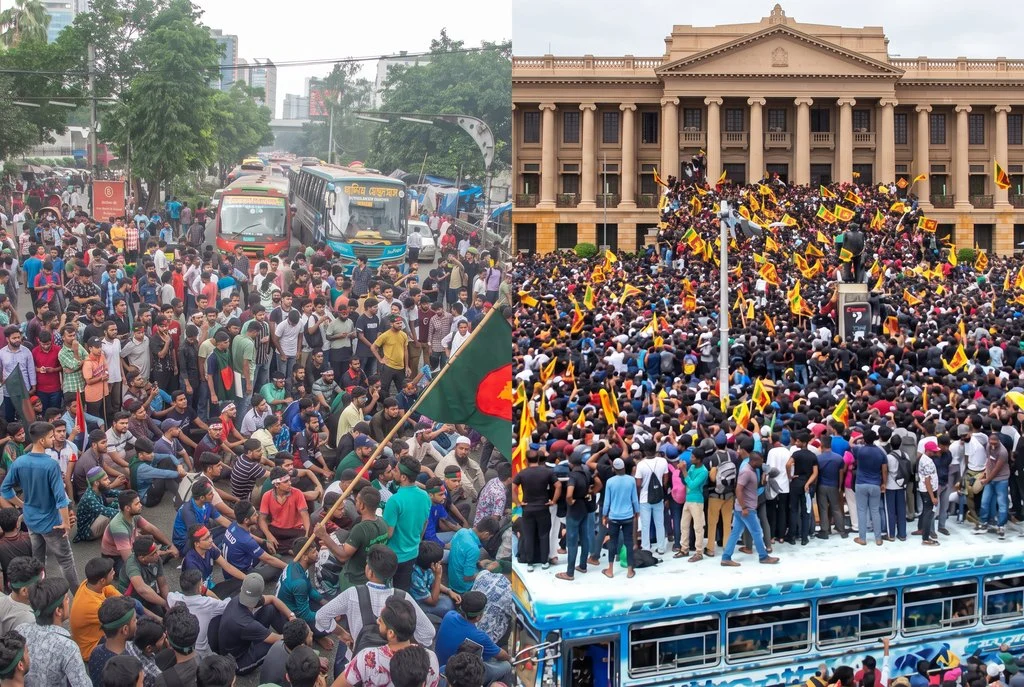
While superpowers clashed in the north and east, a different kind of power shift was happening in the streets of South Asia. The economic hangover of the pandemic, combined with catastrophic domestic mismanagement, pushed desperate populations to the breaking point.
In 2022, Sri Lanka ran out of foreign exchange reserves. Fuel lines stretched for miles, cooking gas vanished, and inflation spiraled out of control. The resulting public uprising, known as the “Aragalaya”, culminated in protesters storming the presidential residence in Colombo. The president fled the country and resigned, a stunning victory for citizen mobilization.
Two years later, a remarkably similar scene played out in Bangladesh. What started in the summer of 2024 as a student protest against a controversial civil service quota system quickly snowballed into a nationwide rejection of an entrenched, autocratic government. Despite severe crackdowns that left hundreds dead and tens of thousands injured, the sheer volume of public defiance forced the prime minister to flee across the border. In both nations, the old political guard was swept away, proving that in the modern era, domestic economic failure is just as lethal to a regime as a foreign army.
The Fall of Damascus
The shockwaves of popular revolt eventually reached the Middle East, toppling a regime that had survived a decade of civil war and international isolation. For fifty-three years, the Assad family ruled Syria with an iron fist, kept afloat by the military backing of Moscow and Tehran.
That lifeline snapped in December 2024. With their allies distracted by conflicts elsewhere and the Syrian economy in ruins, a lightning 11-day offensive by opposition forces swept through the country. The capital fell, the president fled to Moscow, and the dynasty collapsed almost overnight. The new interim leadership, surprisingly, opted for a stance of strict neutrality. Rather than joining the escalating regional wars, the new Syrian government focused on signing natural gas deals and positioning the country as an alternative trade route, attempting to rebuild a shattered nation while the rest of the neighborhood burned.
A Region in Flames
The rest of the Middle East did not have the luxury of neutrality. The cycle of violence ignited in late 2023 rapidly escalated from shadow wars and targeted assassinations into direct, state-on-state conflict. By June 2025, the hostilities erupted into a twelve-day war involving coordinated strikes on nuclear facilities.
The breaking point arrived in early 2026. A massive joint military operation resulted in the assassination of #Iran’s Supreme Leader, creating an immediate power vacuum and triggering an unprecedented asymmetric retaliation. Thousands of drones and ballistic missiles rained down across the region, targeting not just military installations, but critical infrastructure in Gulf nations that had previously managed to stay out of the crosshairs.
The United Arab Emirates, a global hub for commerce and tourism, found itself intercepting incoming ballistic missiles over its capital. Meanwhile, Houthi forces in Yemen leveraged the chaos to seize coastal territories near vital maritime chokepoints, launching strikes at airports and industrial zones to force a broader regional realignment. Global energy markets convulsed as naval blockades were enforced and critical straits were threatened, turning a regional dispute into a crisis that emptied wallets and disrupted supply chains on every continent.
The maps printed in classrooms a decade ago no longer match the territories on the ground. The alliances forged in the twentieth century have fractured into new, unpredictable blocs. Somewhere, a student is protesting a quota, a drone is crossing a strait, and a superpower is redrawing a border. The ground is still moving.
Are All These Events Connected?
It is tempting to look at a globe and see isolated fires. A protest in #Colombo, a trench in #Donetsk, a missile intercepted over #AbuDhabi. But pull back, and the smoke blends into a single, continuous cloud. The connective tissue binding these crises is a mix of fractured economics and diverted attention.
When the pandemic first broke global supply chains, it left developing nations drowning in debt and dangerously dependent on imported food and fuel. Then, the war in Eastern Europe choked off massive portions of the world’s wheat and fertilizer exports, sending commodity prices into the stratosphere. That specific economic shockwave is what ultimately bankrupted Sri Lanka and pushed the streets of Bangladesh to the boiling point.
Meanwhile, the grinding military toll in Europe drained the resources and focus of major global powers. Russia, bogged down in a war of inches, could no longer afford to bankroll its allies in the Levant. Iran, stretched thin by an escalating shadow war, watched its strategic depth evaporate. When a lightning offensive swept through Syria in late 2024, the traditional guarantors of the regime were simply looking the other way, exhausted by crises on their own doorsteps. The resulting power vacuum didn’t just redraw borders; it severed the primary land bridge used to move weapons across the region, forcing remaining actors into desperate, direct confrontations. Every falling domino made the next one wobble.
The maps printed in classrooms a decade ago no longer match the territories on the ground. Alliances forged in the twentieth century have fractured into unpredictable new blocs. Somewhere right now, a student is protesting a quota, a drone is crossing a strait, and a superpower is redrawing a border. The ground is still moving.
Frequently Asked Questions
What triggered the Asian revolutions between 2022 and 2024?
The uprisings in Sri Lanka and Bangladesh were primarily driven by severe economic crises exacerbated by the aftermath of the global pandemic. In Sri Lanka, a lack of foreign reserves and disastrous agricultural policies led to shortages of basic goods. In Bangladesh, widespread anger over a controversial civil service quota system acted as the spark for a broader anti-government movement.
How did the global supply chain change after 2019?
The pandemic accelerated a "decoupling" process between the US and China. Governments and corporations began prioritizing national security and supply chain resilience over pure economic efficiency, leading to restrictions on foreign technology, the onshoring of critical manufacturing, and the creation of distinct, localized digital and trade ecosystems.
What is the current status of the Syrian government?
Following the collapse of the Assad regime in December 2024, Syria is operating under an interim government. The new leadership has pursued a policy of neutrality, focusing on domestic stabilization, integrating various armed factions, and securing international investment for energy and infrastructure reconstruction.
Why did the Middle East conflict expand to include the UAE in 2026?
Following the assassination of Iran's Supreme Leader in early 2026, a massive regional retaliation was launched. The UAE became a target due to its strategic alliances, hosting of foreign military assets, and involvement in regional security dynamics, leading to Houthi and allied forces firing ballistic missiles and drones at Emirati infrastructure and airports.
You Might Also Like
 Geopolitics
The Starlink Shake-Up That Exposed Ukraine’s Satellite Dependency
After a week of throttled connections, Kyiv says Starlink and Starshield are stable again, but the episode has pushed Ukraine...