

SpaceX Starship Shakes Off Engine Trouble and Reaches Orbit for the First Time
Starship Flight 14 lost an engine, hesitated for twenty minutes, then reached orbit and released 26 Starlink V3 satellites. The full story inside.
At 7:48 a.m. Central Time on Monday, the marshland around Starbase, Texas did what it always does when the biggest rocket ever built leaves home. It shook. Residents in Brownsville felt it in their walls, spectators on South Padre Island felt it in their chests, and a 407-foot column of stainless steel climbed out of a dust cloud that rolled across the scrub like a slow tide.
Flight 14 was supposed to be the flight. Thirteen previous full-scale tests had all stayed on deliberately safe, suborbital arcs — trajectories designed so that even a completely dead Starship would fall harmlessly into a pre-planned ocean grave. Monday was different. Monday, SpaceX was going to orbit for real, with no safety net, carrying 26 paying customers’ worth of hardware in its belly.
And for about twenty minutes, nobody in the control room was sure it would happen at all.

The morning the ground shook in South Texas
The launch window opened at 7:15 a.m. local time and stayed open for 75 minutes. SpaceX didn’t need most of it. Weather was, in spokesperson Dan Huot’s words, “gorgeous,” and the stack lifted near the start of the window with all 33 Super Heavy engines roaring.
The first minutes were textbook. Max Q — the moment of peak aerodynamic stress — came and went. Then hot staging, SpaceX’s signature maneuver where the upper stage essentially punches itself free from the booster with its own engine fire, rocket separation by brute force. The booster flipped back toward home while the ship lit all six of its Raptors and ran for space.
Super Heavy, meanwhile, was not having a perfect day. Only 31 of its 33 engines relit for the boost-back burn, the same class of gremlin that haunted the July flight when just eight of thirteen engines relit before a hard landing. SpaceX had swapped hardware filters and rewritten relight software specifically to fix this. It mostly worked. The booster splashed down in the Gulf of Mexico to applause on the livestream — no tower catch this time, by design.
Twenty minutes of silence in the control room
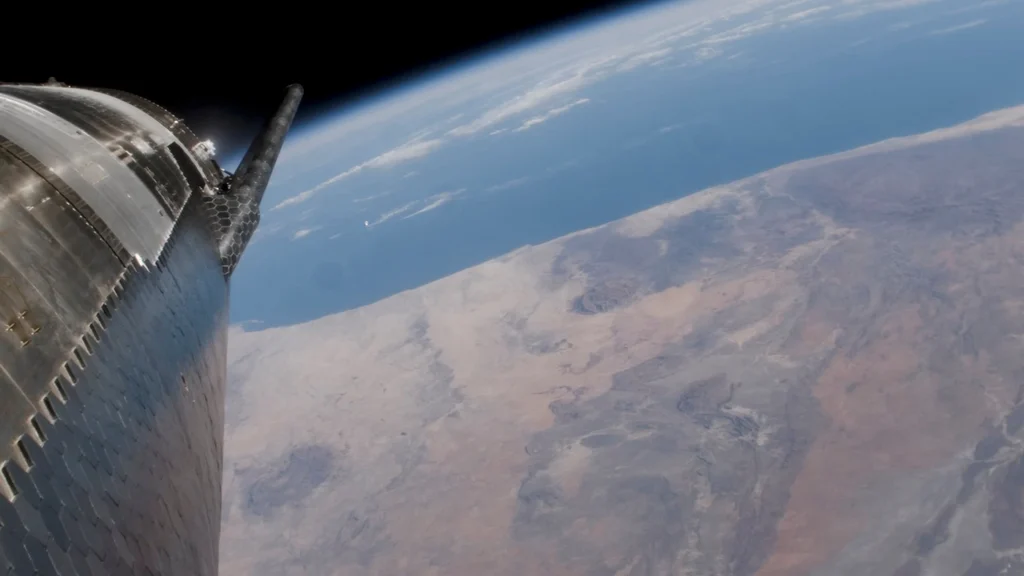
Then came the wobble. During the ship’s first burn, one of its vacuum-optimized Raptor engines shut down early. The vehicle was already in space, but space is not orbit. Orbit means speed — roughly 28,000 km/h, fast enough to keep falling around the planet forever instead of back into it.
Huot initially told viewers SpaceX would skip the orbital insertion burn. Engineers went quiet, poring over telemetry on the three sea-level engines that would have to perform both the push into orbit and, hours later, the deorbit burn that brings the ship home. Going orbital with a sick spacecraft is genuinely dangerous. A dead Starship in orbit cannot be easily dragged back down. It becomes a multi-ton hazard drifting below the International Space Station’s 400 km altitude and China’s Tiangong station, which flies above 340 km, while Starship’s lane sits at about 275 km.
Twenty minutes in, the call flipped. The remaining engines looked healthy. The vacuum engine that quit wasn’t needed again. Go for orbit.
“Starship is orbital,” Huot announced, and the control room erupted. “Starship’s in space. It’s in orbit. That feels so good to say.”
Twenty-six satellites out the door
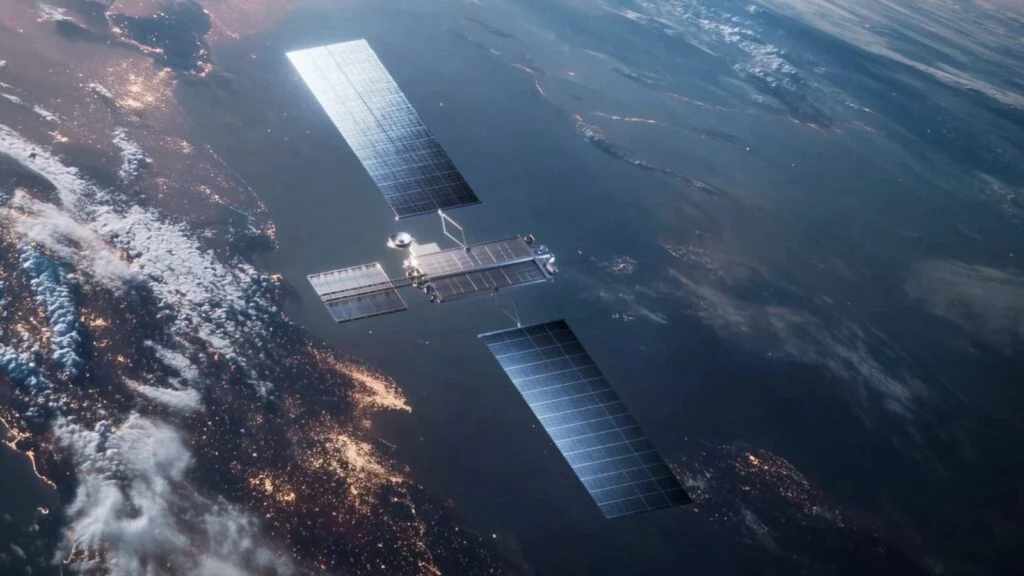
Once orbital, Starship got to work. Over about half an hour it fed 26 Starlink V3 satellites out of a narrow slat in its side, one after another, like a very expensive Pez dispenser. It was the first operational payload Starship has ever released, and SpaceX later confirmed contact with every single one of them.
These are not ordinary Starlinks. Each V3 satellite is designed for up to 1 terabit per second of downlink and 160 Gbps of uplink — a tenfold and 22-fold jump over the V2 generation. Upgraded modem chips handle 64 times more throughput, six 400-gigabit space lasers per satellite weave them into a petabit-scale laser mesh, and four quad-band antennas working across Ka, E, V and W bands push backhaul capacity to 1.2 Tbps. SpaceX says they can begin serving customers within weeks, joining a constellation of roughly 11,000 satellites that already serves some 12 million internet customers.
Three of the satellites drew a slightly unusual assignment. Fitted with camera suites, they turned around after deployment to photograph Starship’s heat shield in orbit, feeding engineers imagery of the tiles that must survive reentry heating above 2,500 degrees Fahrenheit on the way down.
Coming home early
The original script called for six laps of Earth over nearly ten hours, ending in a controlled splashdown in the Pacific west of Chile. At the first checkpoint, about an hour and 28 minutes into flight, mission controllers reviewed the ship’s health and chose caution over endurance. Starship would take its first checkpoint and come back early.
The deorbit burn fired around two hours and 12 minutes in, and the ship reentered and splashed down in the Pacific after roughly a three-hour flight. Shorter than planned, yes. But every mission objective that mattered — orbit, satellite deployment, contact with all 26 payloads, a controlled return through the atmosphere at orbital speed — was checked off. Even the livestream host, usually measured, called it “a wildly successful day.”
Wall street shrugs, and here is why
You would expect confetti in the markets. There wasn’t any. Instead of rallying when trading opened after orbit insertion, SpaceX stock slipped about a percent, extending a roughly three percent slide over five days.
Investors are watching what Flight 14 did not do. Neither stage was recovered. Super Heavy still misfires engines on return burns. The ship has never been caught, refueled in orbit, or flown again — and full reusability is the entire economic thesis. NASA is also on a clock, hoping to test Starship with crew in orbit as soon as next year ahead of a lunar landing attempt around 2028. One orbital lap, however dramatic, does not retire those risks.
Brussels keeps one eye on Starlink
While Starship was circling Earth, Europe was writing rules about it. Euractiv reported the same day that EU member states have added a SpaceX monitoring clause to the bloc’s spectrum law, a legislative signal that regulators intend to watch closely how the company’s constellation uses European airwaves.
The clause lands after a bruising year. In May the European Commission proposed opening its 2 GHz mobile satellite spectrum to bidding from 2027 while capping non-EU operators at a third of the available frequencies and reserving the rest for European players. SpaceX publicly attacked the tender design in June. Orbit or no orbit, Starship’s future is now as much a political negotiation as an engineering one.
The moon is next, and Mars is watching
Everything from here accelerates. Starship is the lunar lander NASA’s Artemis program is betting on, and before it can touch the Moon it must master propellant transfer in orbit — moving super-chilled fuel colder than minus 162 Celsius between ships in space, perhaps a dozen times or more per lunar mission. Nobody has ever done it.
NASA’s near-term machine keeps moving too. Just a day before Flight 14, the Falcon 9 and Dragon capsule for the Crew-13 mission rolled vertical at Space Launch Complex 40 in Cape Canaveral, completed an integrated static fire, and now target liftoff no earlier than 11:10 a.m. EDT on October 1, carrying NASA astronauts Jessica Watkins and Luke Delaney, CSA astronaut Joshua Kutryk and Roscosmos cosmonaut Sergey Tetyeryatnikov to the ISS. Watkins becomes the first NASA astronaut to launch on Dragon twice.
And Musk’s horizon remains absurdly large. Cargo Starships aimed at Mars around 2028. A self-sustaining city of a million people after that. A planned 100 billion dollar launch complex in Louisiana, dubbed Starbase Louisiana, with more than a dozen towers and a claimed capacity of 30-plus flights a day, first launch targeted as soon as 2029.
“The design is capable of full reusability,” Musk said this month of the V3 vehicle, one of the most confident sentences he has ever uttered about Starship. “Of that I am certain.”
The shake that matters
There is a quote from this story cycle that keeps rattling around in my head, and it isn’t from a billionaire or a regulator. Joseph Gonzalez, an aerospace engineering professor at the University of Illinois, described his family in Brownsville telling him that their walls shake every time a launch happens.
On Monday the walls shook again. But this time, when the noise faded, there was a 124-meter rocket circling the planet at 28,000 km/h, 26 fresh satellites blinking awake above it, and a control room full of people cheering a sentence they had waited years to say.
Starship is orbital. Everything else — the Moon, Mars, the hourly launch cadence, the cities in the sky — is now a question of when, not if.
You Might Also Like
 Geopolitics
The Starlink Shake-Up That Exposed Ukraine’s Satellite Dependency
After a week of throttled connections, Kyiv says Starlink and Starshield are stable again, but the episode has pushed Ukraine...