

The Great September 2026 AI Shake-Up and the Viral Man Who Out-Chatted the Machines
Claude Opus 5.5, GPT-6 Astra and an anonymous "Space Bunny" rewired the leaderboards this September, while a 32-year-old ex-Google artist proved the rarest chatbot of all is still a human being.
The most honest chatbot of 2026 has no model at all. It has a keyboard, a pair of tired hands, and a 32-year-old former Google project manager named Tucker Bryant. His 14-by-48-foot San Francisco billboard promised “the leading chat interface powered by AI,” with a tiny asterisk confessing that here, AI stands for “Average Individual.” Every answer on ChatTJB began as Bryant himself typing it back, in shifts of up to ten hours a day. Within a week, more than 11,000 people had sent roughly 15,000 prompts. At the peak, 5,000 arrived in a single hour. By mid-August the counter had passed 100,000 questions, and over 10,000 volunteers had signed up to take turns being the “AI,” with the waitlist growing by about 1,000 names a day. The story refused to fade into September, because it landed squarely in the strangest leaderboard month in years.

The brains race — Claude on top, OpenAI at its throat
September was a release stampede. Anthropic shipped #Claude Opus 5.5 on September 21 and Claude Sonnet 5.5 on September 27, while OpenAI fired back with GPT-6 Luna on September 21 and GPT-6.1 Sol on September 28, according to the release log tracked by LLM Stats. On the Artificial Analysis intelligence index, which lines up more than 250 models, Claude Opus 5.5 at its max setting sits at number one with a score of 58, Sonnet 5.5 close behind at 56. OpenAI’s GPT-6 Astra and Google’s #Gemini 4 Argon tie at 53. Over at #LLM Stats, GPT-6 Astra owns GPQA Diamond, the toughest science benchmark, at 96.0 percent, Claude Opus 5 still holds first place in head-to-head coding arena votes, and Moonshot’s Kimi K3 remains the open-weights model to beat at 93.5 percent.
The easy tests are already over. AIME 2025 math is saturated at 100 percent, and LLM Stats’ price curve shows the cheapest route to a 40-plus score model has collapsed 98 percent since mid-2024, from $0.09 to about $0.002 per score point. What remains is the messy stuff, like Terminal Bench, where the best agents still convert only about half their runs.
The usage race — a nameless bunny outruns everyone
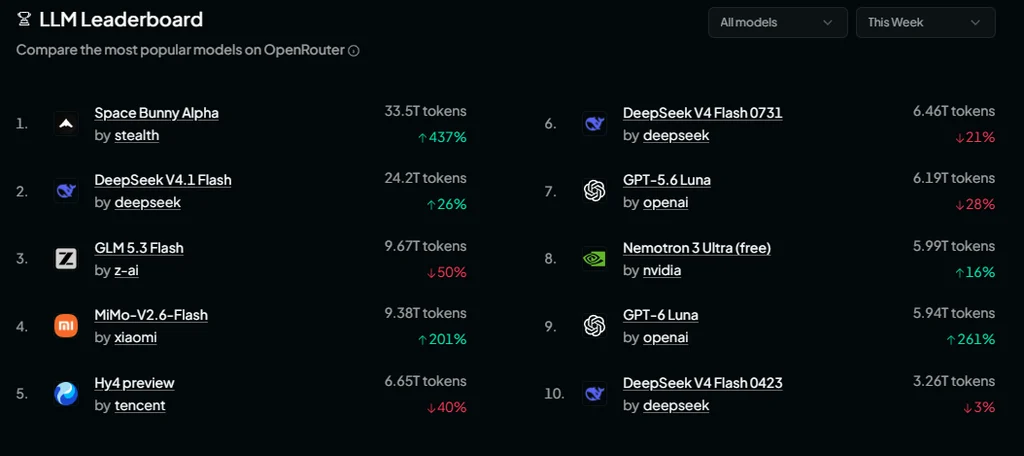
Then there is the scoreboard money cannot buy: real traffic. On OpenRouter’s rankings, which count tokens actually processed, the number one model of late September is one nobody can name. Space Bunny Alpha, a stealth model from an anonymous provider listed on September 23, burned through 33.5 trillion tokens in a week, up 437 percent. #DeepSeek V4.1 Flash took second at 24.2 trillion, and Xiaomi’s MiMo-V2.6-Flash surged 201 percent. Developer forums are full of tokenizer sleuths convinced the bunny is a repackaged MiniMax preview. Nobody has confirmed it, which is somehow the point.
Market share tells the same story from another angle. Google leads requests at 21.5 percent, DeepSeek breathes on its neck at 21.4 percent, #OpenAI sits at 18.3 percent, and anonymous stealth models hold 10.5 percent, comfortably ahead of Anthropic’s 2.5 percent. The labs winning the intelligence charts are not automatically winning the traffic charts. Price explains much of it: Artificial Analysis’ cost-per-task column puts GPT-6 Luna (low) under half a cent per task, while speed charts crown Inception’s Mercury 2.5 above 700 tokens per second. Context has become its own arms race, with Meta’s Llama 4 Scout listed at ten million tokens. Intelligence is a trophy. Throughput is a habit.
Why one typing man owns this story
Which returns us to Bryant, and why he became the topic. His project is a joke with a thesis: “cognitive surrender,” the term coined by Wharton researchers Steven D. Shaw and Gideon Nave, whose 2026 work found that people who followed wrong AI advice scored 15 percentage points worse than people given no advice at all. Bryant caught himself asking a chatbot whether to wear short or long sleeves on a 65-degree day and decided to push back the only way an artist can, by becoming the chatbot. He even sells #ChatTJB Pro for five dollars a month, mostly to pay off the billboard. “If I don’t worry about spelling mistakes, I can type fast,” he told The San Francisco Standard.
The detail people repeat is the honeymoon message: a newlywed asking, on night one, whether it was normal to not feel relaxed. A frontier model would have emitted a list. Bryant answered like a person. Fortune watched the project shift, in his words, “from a surreal piece of satire into a place for people to chat in earnest,” while Shaw observed that its users “want to remain human.”

September’s leaderboards measure everything except what people actually needed at 2 a.m. The smartest model scores 58. The busiest model has no name. And the chatbot that strangers trusted with their honeymoon doubts runs on coffee, typos and a waitlist of 10,000 volunteers who just want to type back. The machines processed trillions of tokens this month; one average individual processed the question we keep avoiding. When the answer finally arrives, do we want it to be right, or do we want it to be someone?
Quick Answers to Shake Up Your AI Leaderboard Knowledge
Which AI model ranked smartest in September 2026?
Anthropic's Claude Opus 5.5 (max setting) leads the Artificial Analysis intelligence index at 58, while OpenAI's GPT-6 Astra tops the GPQA Diamond science benchmark at 96.0 percent on LLM Stats.
What is Space Bunny Alpha on OpenRouter?
An anonymous "stealth" model listed on September 23, 2026 that climbed to the top of OpenRouter's weekly usage with 33.5 trillion tokens. Its creator remains undisclosed; community tokenizer tests point to a MiniMax preview, unconfirmed.
Why did Tucker Bryant's ChatTJB go viral?
His San Francisco billboard advertised a chatbot "powered by AI" where AI meant "Average Individual": Bryant typing every reply himself. The parody of AI dependence pulled more than 100,000 prompts and 10,000 volunteer typists.
Which companies lead real-world AI usage right now?
By request share on OpenRouter, Google (21.5%) and DeepSeek (21.4%) edge out OpenAI (18.3%), with anonymous stealth models at 10.5% and Anthropic at 2.5%.
You Might Also Like
 Apple Ecosystem
Apple HomeView Could Shake the Smart Home Race
Apple’s new $299 display tries to make the home screen personal, private, and hard to ignore.
 Artificial Intelligence
How Meta’s Muse Wonder Plans To Shake Up The AI Agent Market
The tech giant just dropped its most capable models yet, aiming to turn passive chatbots into proactive digital partners that...
 Artificial Intelligence
The GPU Gold Rush Died. A New One Was Born. And This Time, It’s Personal
Remember 2021? Of course you do. You couldn’t buy a graphics card to save your life. Every RTX 3080, every...