

Shake Your Daily Grind With Manus 2.0 And Its Wild New Cue AI Agents
If you thought the AI agent race was just about chatbots that can write a decent email, you are in for a massive shake-up. Manus, the AI startup that recently made headlines for a massive (and ultimately blocked) Meta acquisition, just dropped Manus 2.0. Honestly, it feels less like a software update and more like we just got handed a team of digital interns who actually do their jobs.
Alongside the core platform upgrade, they also rolled out a standalone app called Cue, which essentially gives AI agents their own phone numbers, wallets, and computers. Let’s break down what this actually means for you and why the tech world is suddenly buzzing about it.

The Architecture Shake-Up
Manus didn’t just slap a new coat of paint on their software; they rebuilt the engine. Version 2.0 runs on a brand-new in-house system called Cascade. The whole idea here is “on-demand loading.” Instead of bogging down every single task with heavy, unnecessary tools, Cascade only pulls in specialized capabilities when a project actually needs them.
The real-world numbers behind this are pretty wild. According to Manus’s internal testing, the new Cascade framework used 23.2% fewer tokens, finished tasks 28.2% faster, and cut operating costs by a staggering 32%.
They also introduced something called a Cloud Computer. This is a dedicated environment you can buy that keeps running even when your laptop is closed. If you have long-running tasks, background automations, or you are hosting a multiplayer game server, the Cloud Computer keeps the wheels turning 24/7. Speaking of automations, they are no longer just tied to a rigid schedule. You can now trigger a workflow based on an event—like a new email, a Slack ping, a calendar invite, or an update in Notion.
Manus Studio Gets Seriously Creative
The desktop app has been completely revamped and renamed to Manus Studio. It is no longer just a place to generate text or code; it is a shared workspace for documents, spreadsheets, websites, and now, full-blown media creation.
The two biggest additions here are the Video Editor and Game Dev environments.
With the Video Editor, Manus hands you an actual timeline. You can see the clips, images, text, motion graphics, and audio laid out just like you were using Premiere Pro or DaVinci Resolve. You can swap out a piece of background music, replace a product shot, or tweak the text, and then hand it back to the AI to keep refining. It is explicitly built for short-form content like 30 to 60-second product ads, tutorials, and vlogs. There is also an “Alchemy mode” that handles the creative directing, scripting, and storyboarding all at once.
Game Dev is equally impressive. You can build games using AI-generated code, images, and video, and then publish them as playable websites. The multiplayer functionality is where the Cloud Computer really shines, as it handles the server hosting and networking for you. Want to build a 3D racing game with your friends? Manus now makes that just a few clicks away.
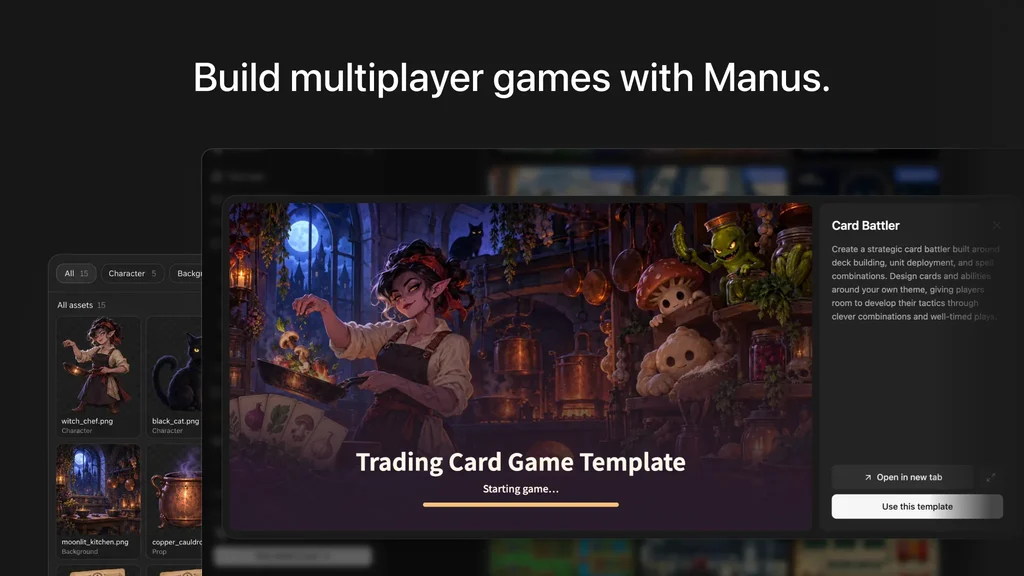
Cue – Hiring Your Digital Workforce
This is where things get genuinely sci-fi. Cue is a brand-new standalone app for personal agents that runs on the same infrastructure as Manus. But instead of just asking a chatbot a question, you are basically deploying independent digital workers.
Every single agent you create in Cue gets its own unique identity: an email address, a phone number, a digital wallet, and its own computer.
Think about what that means. An agent can answer phone calls on your behalf and leave you a summary in the app. It can send emails, scan a restaurant’s QR code to order your food, hold your place in a digital line, or make payments within a strict budget you set.
But the coolest feature is multi-agent collaboration. You can throw several agents into a single group chat, give them a shared goal, and watch them divide the labor. Let’s say you are planning a product launch in New York. One agent researches venues, another takes that data and builds a shortlist, and a third drafts the pitch deck. You just sit back, monitor the chat, and act as the CEO making the final calls.
The Meta Drama You Might Have Missed
To really understand this launch, you have to look at the backstory. Late last year, #Meta tried to buy Manus for a cool $2 billion. However, Beijing regulators stepped in and ordered the cancellation of the deal, forcing the two companies to part ways.
Fast forward to today, and Meta has launched its own personal agent app called #Muse. Muse is doing incredibly well, racking up millions of downloads and sitting at the top of the app store charts. But while Meta’s Muse acts as a singular, highly personalized assistant that follows you across devices, Manus 2.0 is taking a completely different route. They are betting that the future isn’t one single AI assistant, but a whole team of specialized agents that you manage.
Manus 2.0 shifts the burden slightly. You are no longer just prompting an AI to do a single task; you are managing a team of digital employees. It is a massive shake-up in how we interact with artificial intelligence, moving us away from simple chat windows and into fully autonomous digital workforces.
Cue is currently in early access and free to use if you can snag an invite code, while Manus 2.0 is live on the web, desktop, and mobile. If you have been looking for a way to literally shake up your daily workflow, this might just be the tool that finally lets you clock out early.
You Might Also Like
 Apple Ecosystem
Apple HomeView Could Shake the Smart Home Race
Apple’s new $299 display tries to make the home screen personal, private, and hard to ignore.
 Artificial Intelligence
How Meta’s Muse Wonder Plans To Shake Up The AI Agent Market
The tech giant just dropped its most capable models yet, aiming to turn passive chatbots into proactive digital partners that...
 Artificial Intelligence
The GPU Gold Rush Died. A New One Was Born. And This Time, It’s Personal
Remember 2021? Of course you do. You couldn’t buy a graphics card to save your life. Every RTX 3080, every...